
Tech Trends of the Silicon Forest.
Local leaders and professionals weigh in on tech priorities, hiring, salaries, AI, and more. Get the 2026 Report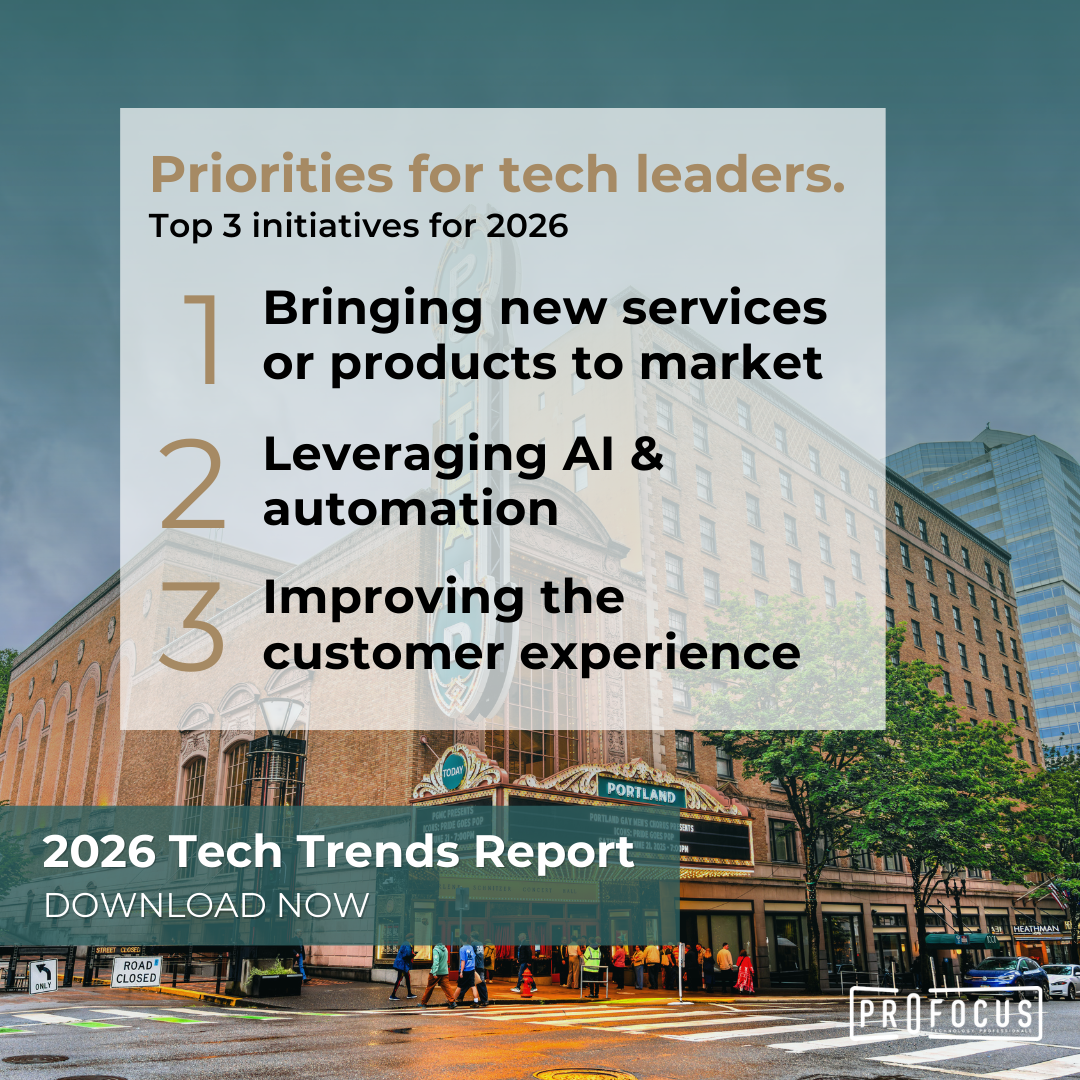
Read the annual Tech Trends Report.
The 2026 Silicon Forest Tech Trends Report is here! Insights and predictions from over 200 local tech leaders and professionals shape the 37-page report – covering topics like AI, salary data, hiring plans, and talent challenges. This year, Portland tech leaders are cautiously optimistic, with 72% of executives expecting revenue growth, yet overwork remains a key concern.
Highlights and hot topics.
The 2026 Silicon Forest Tech Trends Report reveals a few hot topics and trends for our local tech community:
Revenue Increases
58% anticipate revenue growth in 2026 (72% of executives)
Offshore growth
35% expect offshore contractor growth (22% for onshore)
Stable headcount
78% predict internal hiring to stay stable or grow
Tech Priorities
Top 2 priorities for tech leaders: Bringing new services/products to market, Leveraging AI & automation
Salary Data
Portland tech salaries are 12% higher than the national average
Hybrid Work Trends
60% of organizations operate in a hybrid model in 2026
Work-Life Balance
90% rate work-life balance above average or excellent
Connect with our team today to learn more about the trends shaping the tech workforce and the solutions business leaders are leveraging to achieve results.
2026 Oregon Tech Trends: Hiring, AI, Salaries & Workforce FAQs
What are the top tech trends in Oregon for 2026?
The biggest trends shaping the Silicon Forest in 2026 include AI and automation investment, tech modernization, digital product enablement, and continued hybrid workforce models. The full report breaks down how these trends vary by company size and leadership level.
What is the state of tech hiring in the Silicon Forest in 2026?
Hiring is stabilizing — not accelerating. While 58% of organizations expect revenue growth, only 27% anticipate growing internal tech headcount. Nearly half expect teams to remain flat, and enterprise firms are more likely to forecast decreases than growth.
Instead of expanding permanent teams, many companies are leaning on flexibility. Offshore contractor growth (35%) outpaces onshore contractor growth (22%), signaling a focus on cost control and delivery capacity rather than long-term headcount expansion.
The pressure hasn’t disappeared — it’s shifted. Unfilled roles are less common than last year, but overwork is now the top-ranked talent challenge, particularly among managers and individual contributors. The full 2026 Tech Trends Report breaks down how hiring trends vary by company size and leadership level.
How much do tech jobs pay in Portland, Oregon in 2026?
The report confirms that Portland tech salaries are 12% above the national average. Salary expectations vary based on role and level.
For more salary data, check out the full report.
How is AI impacting the Silicon Forest tech industry in 2026?
AI is the #1 tech investment for 2026, with 69% of organizations investing in AI and 65% regularly using it at work. It ranks as a top strategic priority alongside bringing new services to market.
Most teams are leveraging AI for process automation and product development. However, the biggest barriers to scaling AI are data quality and talent capability, highlighting that adoption requires more than just tools — it requires readiness.
What is the current state of hybrid work in Oregon's tech industry?
Hybrid remains the dominant model, with 60% of organizations operating hybrid environments. Small and midsized companies are twice as likely to offer fully remote roles compared to large enterprises.
Are tech skills shortages still a major issue?
Surprisingly, skills shortages rank lower in 2026 than workload and compensation pressures. However, 65% of C-suite leaders plan to invest in upskilling.
Insights from Leaders in the Silicon Forest
“Despite national uncertainty and a challenging local business environment, Oregon’s tech sector is generating momentum. Leaders are rallying with shared urgency — from growth in semiconductor startups and AI companies to new education and workforce partnerships — signaling a renewed commitment to strengthening the region’s tech economy.“
“Heading into 2025, there was real optimism the market would improve, but that shifted quickly in Q1. Many of the leaders we’re talking to now believe 2026 will be the year we all thought 2025 would be – even with uncertainty still in the mix.”
“Burnout is not a badge of honor, it is feedback. If our team is stretched too thin for too long, that is a leadership problem to solve. We are planning to grow, but not at the expense of who we are. In a landscape reshaped by AI, adding headcount is not the default solution. We will grow with purpose, bringing in people whose strengths expand our capabilities and whose values strengthen our culture. When people feel supported and connected to the mission, they do not just avoid burnout, they thrive.”
“Flexibility may attract talent, but culture is what keeps it. The data showing strong work-life balance and flexibility is encouraging, but the lower morale in larger organizations is a reminder that scale can sometimes dilute connection. The real differentiator today isn’t perks, it’s whether leaders build trust, communicate clearly, and create an environment where people can grow without burning out.”
“In times of crisis, I reject the instinct to micromanage and double down on empowerment and empathy. When pressure is high, a team doesn’t need more oversight; they need the psychological safety to innovate and the support to remain resilient.”
“The days of relying on rigidly siloed roles are ending as AI quickly blurs the hard boundaries across development teams. We need to trade gatekeeping and control for empowerment and humility. It’s time to figure out how to help everyone on the assembly line work faster. At Trimble, teams that are helping each other out and leaning into the blurred roles are excelling. Teams sticking to old paradigms will struggle and likely face impending obsolescence.”